
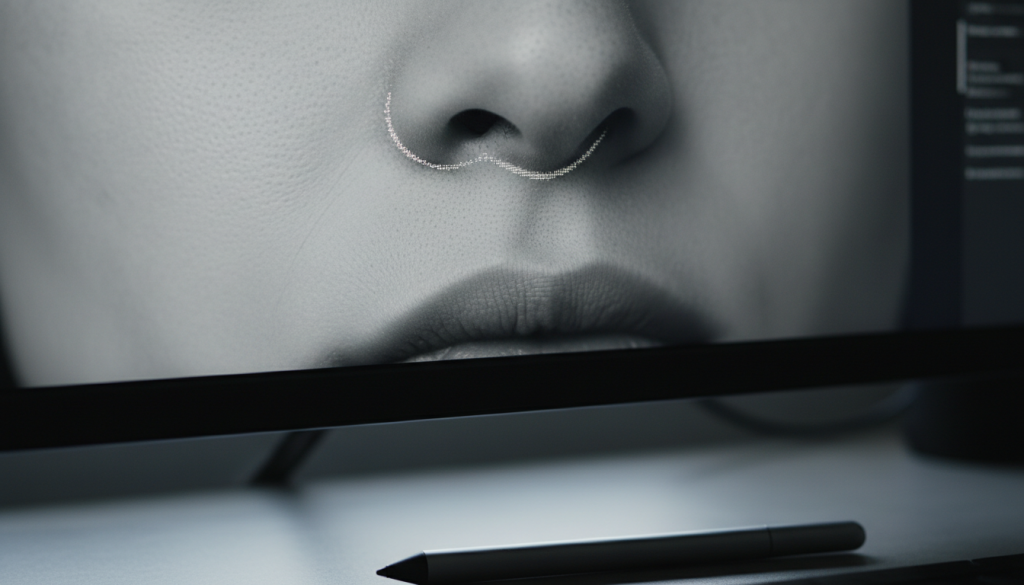
An uncompressed raw portrait file contains a narrow highlight strip running along the crest of a nasal bone under hard key lighting. Shifting the exposure downward by two stops compresses this gradient into deep midtones and alters the spatial boundary between pore highlights and shadow falloff.
When automated neural tools like Retouch4me process such an area, the algorithm identifies localized luminance discrepancies and renders corrective masks based on learned patterns of facial anatomy. An observer examining the resulting layer stack might see a clean surface free of minor blotches and assume that the underlying structural integrity remains intact. However, a cosmetic reduction in blemishes does not guarantee that anatomical volume has been preserved accurately across shifting contrast zones.
Inspecting Local Luminance Boundaries
To determine whether an automated pass respects physical contours, attention must focus directly on high-contrast transition lines. The boundary where the jawline meets the neck or where the edge of an eyelid meets the sclera provides immediate physical evidence. In manual retouching, an editor paints dodge-and-burn strokes along the directional path of muscle fibers, avoiding cross-boundary spill. An algorithm, by contrast, operates on probability matrices that map luminance differences across set pixel blocks.
When reviewing the processed image at two hundred percent magnification, look closely at the darker side of a sharp tonal transition. If the correction introduces a faint, lighter halo or softens the perimeter of the shadow edge, the neural pass has failed to distinguish between a skin irregularity and an anatomical boundary. What you can observe directly is a zone of altered pixel brightness along the contour; what you cannot infer is whether the software miscalculated the facial structure or simply lacked sufficient training data for that specific angle of hard lighting.
Differentiating Organic Texture from Generated Noise
Automated skin-clearing tools often generate separate adjustment layers, such as dodge-and-burn correction masks or high-frequency isolation plates. Evaluating these outputs requires separating what the mask actually modifies from how the eye interprets overall sharpness.
- Micro-contrast along pore walls: Natural pores display a distinct highlight on the light-facing rim and a microscopic shadow on the opposite side. An effective pass leaves this relationship unchanged while leveling broad skin redness.
- Residual planar volume: Broad highlights on cheekbones must retain their three-dimensional curvature. If the corrective mask applies uniform lightening across the midtones, the cheek appears flat regardless of retained grain.
- Uniformity of background falloff: If the correction extends beyond the silhouette into out-of-focus background elements, the tool has misread optical blur as dermal unevenness.
Observing that high-frequency pores remain visible after processing does not mean that skin topography was left untouched. In many cases, neural filters alter midtone contrast so drastically that the preserved pores sit atop an unnaturally flat tonal base, creating a synthetic, paper-like relief.
Evaluating Color Phase and Desaturation
Luminance corrections rarely occur in total isolation from chrominance. When an algorithm lifts shadow depth in uneven skin, it frequently shifts the underlying color saturation. A patch of skin brightened solely through tone curves often loses color purity, taking on an ashen, desaturated appearance compared to adjacent areas.
To evaluate this directly, toggle the individual correction layer on and off while viewing the image through an isolated saturation mask. If the corrected zones register as darker or patchy in the saturation view, the software adjusted luminance without compensating for perceived pigment density. You can observe the exact coordinates of color drift, but you cannot deduce from this alone whether the software lacks chrominance awareness or whether the base raw profile introduced non-linear response curves.
Before concluding that an automated pass is production-ready, disable every layer except the generated correction mask and inspect its opacity along the nostril crease: if the mask displays bright brush-like values bleeding across the crease into the upper lip, the tool has treated an anatomical landmark as a surface flaw.